NSA Suicide and U.S. Cyber Command Suicides: 11 Deaths Reported as Congress Seeks Answers
lastchapterstories.name.ng| Verified
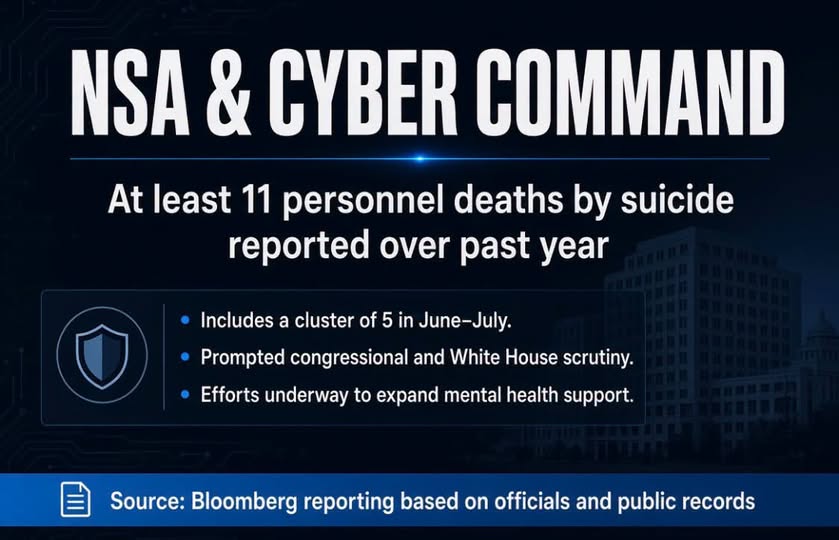
Reports of at least 11 suicides involving personnel connected to the National Security Agency (NSA) and U.S. Cyber Command have raised serious concerns about mental health, working conditions, and support for employees carrying out sensitive national security operations.
The deaths occurred over approximately 12 months ending in September 2026, according to reporting by Bloomberg based on information from U.S. officials and public records. Ten of the deaths reportedly occurred around Fort George G. Meade in Maryland, where the NSA and U.S. Cyber Command are headquartered, while another occurred near an NSA facility in Georgia.
The figures include military personnel, civilian employees, and contractors. The reported concentration of deaths has prompted questions from lawmakers, senior government officials, and military leaders about the demands placed on people working in highly classified intelligence and cyber operations.
The developments have also renewed calls for stronger mental health resources, improved workforce monitoring, and greater attention to the pressures facing personnel in national security roles.
What Happened? Reports Identify 11 Deaths Over 12 Months
The reported figure of at least 11 deaths represents a broader count than the five suicides previously reported during a concentrated period in June and July 2026.
According to Bloomberg’s November reporting, ten people associated with the NSA or U.S. Cyber Command died by suicide around Fort Meade during the 12-month period ending in September. One additional death occurred near an NSA facility in Georgia.
The figures were compiled from public records and information provided by officials familiar with the agencies and the circumstances surrounding the deaths.
The Pentagon does not routinely publish suicide statistics broken down by individual intelligence agencies or military commands. Its publicly available reporting generally groups military suicide figures by service, making it difficult to establish direct year-to-year comparisons for the NSA and Cyber Command workforce.
The reported total therefore provides an important account of the deaths identified by officials and public records, but it should not be mistaken for a regularly published agency-wide statistical series.
Five Deaths Within Approximately Five Weeks
One of the most concerning aspects of the reports involves five deaths between early June and early July 2026.
The deaths occurred within approximately five weeks among people whose work supported U.S. Cyber Command and the NSA. Military officials subsequently treated the concentration as a possible suicide cluster, a designation that calls for attention to patterns and potential shared risk factors.
Earlier reporting by Bloomberg and local Maryland outlet The Banner described the deaths and the concern they generated among military leaders and lawmakers.
The reports also identified individual personnel whose families agreed to discuss their losses publicly. Other families have chosen not to make their relatives’ identities or circumstances public.
Respecting those privacy decisions is particularly important because the deaths involve families dealing with deeply personal losses.
Questions About Workplace Conditions and Operational Pressure
The reports have renewed attention to the working environment within intelligence and cyber operations.
Personnel supporting the NSA and U.S. Cyber Command may work on demanding assignments involving sensitive information, continuous operational requirements, and responsibilities that can be difficult to discuss outside secure professional settings.
Some officials and former intelligence leaders have described the pace of operations as overwhelming. The work can involve prolonged periods of concentration, demanding schedules, and exposure to the emotional pressures associated with national security missions.
However, the reported deaths should not automatically be attributed to occupational stress. Suicide is complex, and the circumstances surrounding each individual death may differ.
Information cited in congressional and media reporting indicates that agency leaders were told the deaths involved different and complex personal circumstances, including financial and other individual difficulties.
A thorough review would need to examine each case independently while also considering whether shared workplace conditions contributed to wider mental health concerns.
Pentagon and Military Response
The deaths have prompted institutional responses aimed at improving support for personnel working in cyber operations.
Following the five deaths reported during June and July, the Pentagon directed U.S. Cyber Command to take additional steps addressing workforce well-being.
Reporting by The Banner described a Pentagon memorandum requiring the command to develop a framework addressing psychological factors affecting personnel and their ability to perform their duties.
The reported measures included reviewing work assignments, examining operational demands, improving career and educational opportunities between demanding assignments, and strengthening access to behavioural health professionals.
The memorandum also called for greater coordination between U.S. Cyber Command and the NSA on mental health support. Obtaining the security clearances required for clinicians working with classified personnel can be a significant obstacle to providing timely assistance.
Congress Seeks Greater Oversight and Mental Health Resources
Members of Congress have also raised concerns about the reported deaths and the need for better workforce support.
Maryland lawmakers have called for additional funding for mental health resources at U.S. Cyber Command. A congressional delegation letter highlighted the unusual concentration of deaths and the challenges associated with working in highly classified operational environments.
The letter also described how some personnel may struggle to discuss work-related pressures with family members or healthcare professionals who do not have the necessary security clearances.
Separately, Representative Sarah Elfreth has pushed for greater tracking of suicides among civilian Department of Defense employees. The proposal reflects concerns that existing reporting systems may not provide a complete picture of deaths involving the civilian workforce.
These efforts have placed workforce mental health and the availability of appropriately cleared professionals among the issues receiving congressional attention.
vanhollen.senate.gov+1
Is There Evidence of Foreign Involvement?
The online discussion surrounding the reported deaths has included speculation about possible foreign interference, including suggestions involving Russia.
However, no credible evidence identified in the reporting reviewed establishes a connection between Russia or another foreign government and the deaths.
The fact that the NSA and U.S. Cyber Command conduct sensitive intelligence and cyber operations does not, by itself, establish that the reported suicides were connected to espionage, sabotage, or foreign activity.
Any allegation of outside involvement would require specific investigative evidence. Until such evidence is made public, foreign interference should not be presented as an established explanation.
Transparency and Support for Affected Families
The deaths have highlighted the importance of providing families with reliable information while respecting the privacy of those who have died.
Families deserve appropriate communication and support, particularly when their relatives served in positions involving sensitive national security responsibilities.
There is also a broader institutional question about whether employees, military personnel, and contractors have sufficient access to mental health professionals who understand the particular pressures associated with classified work.
The reported response from the Pentagon and congressional representatives indicates that these concerns are receiving attention. However, the effectiveness of new measures will depend on their implementation and whether personnel can access meaningful support when they need it.
NSA and U.S. Cyber Command Suicide Reports – Key Details
| Detail | Information |
|---|---|
| Agencies involved | National Security Agency and U.S. Cyber Command |
| Reported number of deaths | At least 11 |
| Reporting period | Approximately 12 months ending September 2026 |
| Deaths around Fort Meade | 10 reported |
| Death near an NSA facility in Georgia | 1 reported |
| Five-death period | Early June to early July 2026 |
| Workforce categories | Military personnel, civilians, and contractors |
| Main location | Fort George G. Meade, Maryland |
| Institutional response | Pentagon workforce and mental health measures |
| Congressional response | Oversight briefings and calls for additional support |
| Common cause established | No |
| Foreign involvement established | No credible evidence identified |
What Happens Next?
The central questions concern whether the reported deaths shared any identifiable risk factors, whether existing mental health services were sufficient, and whether the institutional changes ordered by the Pentagon will improve conditions for personnel.
Congressional scrutiny may also lead to further proposals for tracking civilian employee deaths and strengthening mental health programmes across national security agencies.
For now, the available information supports concern about the number and concentration of deaths, but it does not establish a single explanation for them.
A careful, evidence-based response will require continued attention to individual circumstances, meaningful support for affected families, and sustained efforts to protect the well-being of people working in demanding national security roles.
Disclaimer: This article summarises publicly reported information about suicides involving personnel connected to the NSA and U.S. Cyber Command. The reported figure of at least 11 deaths is based on reporting citing U.S. officials and public records; it is not a regularly published agency-wide Pentagon statistic. The circumstances of individual deaths vary, and no single cause has been established. Claims of foreign involvement remain unsupported by the evidence reviewed. This article does not establish that workplace conditions caused the deaths.
For more updates, please check our social media platform
Thank you for reading.